
Posted On
Topics
Alumni
Profiles
Share


For Dorothea “Dee” (Nocera) Buckingham ’71, uncovering untold stories is both a professional calling and a personal passion.
A former librarian turned award-winning author, she has spent decades researching World War II–era Hawai'i, focusing on the women and children whose lives were profoundly shaped by the war but rarely included in its narratives.
“I want people to see what it meant to live in a war zone,” she said. “Women digging trenches at schools. Teachers preparing their classrooms. Children being evacuated. Military wives told to leave. I wanted those pictures in the frame.”
Today, Buckingham is recognized as one of the leading interpreters of Hawai'i’s civilian wartime experience. She has published nine books, and her newest historical novel, Code Name Rascal—inspired by the little-known Women’s Air Raid Defense (WARD)—was released in December 2025.
From Emmanuel to the Edge of the Pacific
Buckingham’s path to Hawai'i began in Newark, N.J., and ran through the Fenway.
Raised in an Italian Catholic family, she knew that if she went away to college, it would be to a Catholic women’s school. Boston itself was part of the draw—the city’s energy and proximity to cultural and intellectual life. Emmanuel matched that setting: serious but not staid, ambitious without pretense. She arrived planning to study English and journalism at a time when “hardly anybody was considering women journalists” and eventually gravitated toward sociology, where the department’s growing focus on activism and social analysis resonated deeply.
A Western Civilization professor spoke matter-of-factly about students visiting the pyramids or traveling to Rome—assumptions that, at first, felt aimed at someone else.
“As a first-generation kid from Newark, I thought, ‘Well, that’s nice for everybody else,’” Buckingham said. “But she kept saying it until I started believing it.”
That belief—that students belonged in the wider world—proved prophetic. After Emmanuel, marriage to a Marine Corps pilot took Buckingham across the continent and the globe: to Canada, several U.S. states, Japan, and, eventually, Hawai'i, where the couple first arrived in 1983 and later chose to retire. Along the way she raised a family and returned to graduate school at age 40.
“I want people to see what it meant to live in a war zone. Women digging trenches at schools. Teachers preparing their classrooms. Children being evacuated. Military wives told to leave.

At the University of Hawai'i’s library school, Buckingham’s practicum at the Hawaii State Archives brought her face-to-face with some of the islands’ most painful histories. Working with the Department of Health intake ledgers from the Hansen’s disease (leprosy) settlement at Kalaupapa, Molokai, she was startled to realize how many entries belonged to children as young as five or six—children removed from their families and sent away for life.
That shock became the seed of her novel My Name Is Loa, a coming-of-age story set inside the reality of Kalaupapa. It also crystallized a pattern that now underpins Buckingham’s work: archival curiosity turning into ethical obligation, and then into story.
Later, as a community college librarian, she attended a colleague’s presentation on civilian deaths at Pearl Harbor—an aspect of December 7 she had never encountered. One case lodged in her mind: a local mother, Gussie, who lost two daughters and a nephew when faulty American anti-aircraft shrapnel fell on her home.
“As a mom, my big question was: how did she get up in the morning?” Buckingham said. “And then I learned she’d also had a stillborn. I started researching civilian deaths, and I thought nothing could be more horrific—until I found another family who lost almost everyone at a noodle stand in Chinatown.”
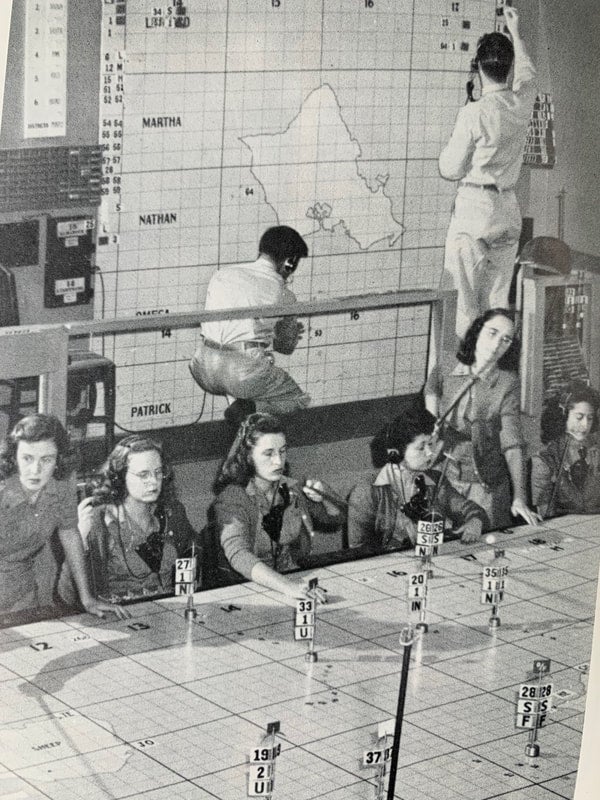
What began as an attempt to understand individual grief grew into a larger project: columns in a local paper, a proposed nonfiction book on women in World War II Hawai'i, and, when no publisher bit, years of private research. She interviewed women who had volunteered for the Women’s Air Raid Defense (WARD), found their descendants, and followed the paper trail wherever it led.
“It was dominoes,” she said. “One woman would introduce me to another. I got hooked.”
Shuffleboard Pilots and Secret Clearances
That work eventually became Code Name Rascal, Buckingham’s historical novel about the WARD, a civilian unit of women who worked on Oahu, plotting aircraft positions in real time.
Known informally as “shuffleboard pilots,” WARD members received radar information in an underground facility and moved markers across a floor-sized map, tracking incoming aircraft, separating friend from foe and, when necessary, triggering air-raid alarms. It was highly technical work with enormous consequences.
“What I want readers to understand is that this was the first organization of women given secret clearance,” Buckingham told Hawai'i Public Radio. “They were the ones who called the air raids, and that’s a big responsibility. It shut down businesses, transportation, communication—life just stopped. I want readers to fall in love with them and respect them.”
Her novel, grounded in two decades of research and interviews, follows four fictional women—a Honolulu socialite, a New Jersey journalist, a Texas aviatrix and a Navy officer’s wife—whose intersecting stories offer a layered portrait of wartime Hawai'i’s class, race and gender divisions.
Critics have already taken notice. Kirkus Reviews has praised Code Name Rascal as belonging beside canonical World War II novels, and Midwest Book Review called it “rich in emotional depth and historical detail,” with “evocative prose and richly drawn scenes” that bring a rarely told chapter of history to life. The novel has also been short-listed for the Hemingway War Fiction Award, with final decisions expected in 2026.
Buckingham’s range extends beyond adult historical fiction. Her contemporary young adult novel, Staring Down the Dragon, about a teenager returning to school after cancer treatment was named an American Library Association Best Book for Young Adults. And her middle-grade time-travel adventure Forgotten Oath, set between 1830s Hawai'i Island and present-day Honolulu, recently earned a Moonbeam Children’s Book Award silver medal.
One measure of her standing in Hawai'i came when Kamehameha Schools, a K–12 school system for Native Hawaii'ian students, added My Name Is Loa to its reading list—an honor Buckingham describes, as a non-Native, mainland-born writer, as “a big deal.”

In 2023, Buckingham and her husband, Jack, collaborated on World War II Hawaii, part of Arcadia Publishing’s Images of America series.
Jack, a retired U.S. Marine Corps lieutenant colonel and docent at Pearl Harbor Aviation Museum, and Dee spent months in archives, ultimately copying more than 1,500 historical photographs before narrowing them down to a little over 150. The book ranges from familiar wartime scenes to the unexpected: Mary Kawena Pukui, the renowned Hawaiian scholar, weaving camouflage nets; women digging trenches on school grounds; a three-year-old girl returning from an internment camp; a Japanese American father embracing his son returning from the famed 442nd Regimental Combat Team.
Dee’s curatorial eye ensured that women and children appear not on the margins but at the center of the story.
Back to the Fenway—Where It All Began
For all her immersion in Hawai'i’s history, Buckingham’s community remains rooted, in part, at 400 The Fenway. A 40th Reunion visit rekindled friendships that deepened during the pandemic, when a group of about 15 members of the Class of 1971 began meeting regularly on Zoom. The calls continue twice a month as classmates navigate retirement, widowhood, grandchildren, and late-career chapters.
“With age, a lot of us are becoming widows, we’re seeing grandchildren grow up, we’re hitting all these life milestones,” she said. “It’s become this really comfortable support.”
As she looks ahead—returning to campus for her 55th Reunion and to a new, darker novel about regulated prostitution and a sex strike in wartime Honolulu—Buckingham’s hopes for her readers remain disarmingly simple.
She wants them to understand Hawai'i’s history more fully. She wants them to recognize the women of WARD and the mothers in bomb trenches as central to the story of World War II, not side notes.
But more than that, she hopes her books send readers back to their own living archives.
“There’s all this talk about ‘untold stories,’” she said. “Well, stay home. Turn around. Ask your grandmother, ask your mother, ask your aunties. These women were just regular people doing normal things—and they all had extraordinary stories.”